How Do Cartoons Move? A Simple Intro to Animation for Curious Kids (Ages 8–12)
Your child laughs at a cartoon, then asks a surprisingly big question: “How do they make it move?” It’s one of the best questions a curious kid can ask — because the answer is simpler, and more magical, than most people think.
Animation isn’t just for big studios. At its heart, it’s a creative skill any child can start learning — with paper, a pencil, and a little patience. Here’s a simple intro to help your child understand how cartoons come to life, and how to start making their own.
What is animation, really?
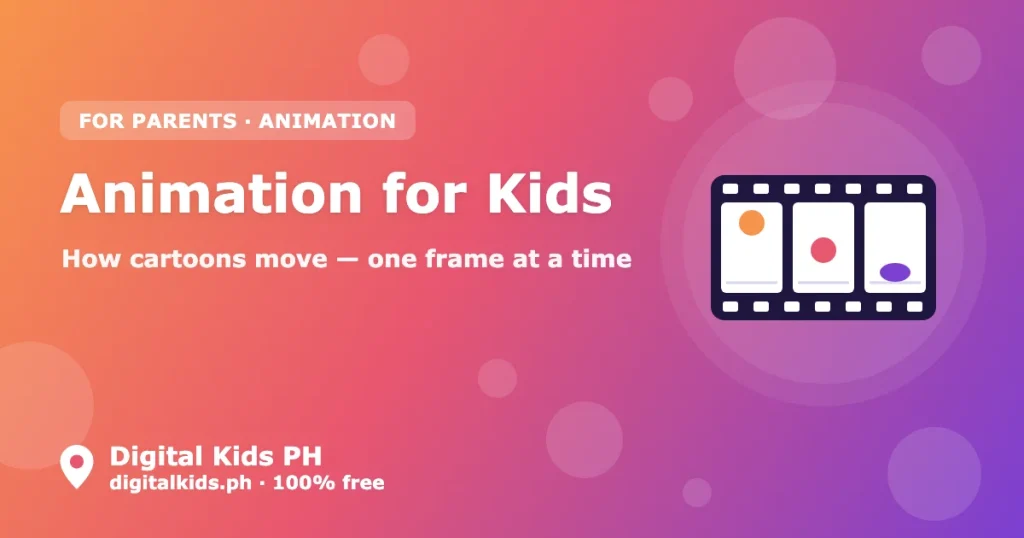
Animation is a clever trick on the eyes. An animator draws many pictures, each one just a tiny bit different from the last. When those pictures are shown quickly, one after another, our brain blends them together — and the drawing seems to move.
Each single picture is called a frame. Many cartoons use around 12 to 24 frames for every second of movement. That means even a short, five-second scene can take dozens of drawings!
The building blocks of animation
Every animation, from a simple flipbook to a full movie, is built from the same few ideas:
- Frames: the individual pictures that make up the movement.
- Order: frames must be in the right sequence — mix them up, and the movement looks broken.
- Small changes: tiny differences between frames make movement smooth; big jumps make it choppy.
- Timing: how fast the frames play changes the feeling — slow and gentle, or quick and bouncy.
- Story: great animation isn’t just movement — it shows a character doing something with a purpose.
Why animation is a great skill for kids
Animation mixes art, logic, and storytelling in one activity. Kids practice patience (one frame at a time), sequencing (putting steps in order — the same thinking behind coding), and observation (noticing how a ball bounces or how a person walks). It also builds real creative confidence: there’s nothing quite like watching your own drawing move for the first time.
It’s a real-world skill, too. Animation is used in cartoons, games, ads, apps, and online lessons — and Filipino animators have long worked on shows watched by kids around the world.
How to nurture a young animator
1. Start with a paper flipbook
Grab a small notebook or a stack of sticky notes. Have your child draw a simple stick figure or a bouncing ball in the corner of each page, changing it just a little each time. Flip the pages quickly — and watch it move. It’s the oldest animation trick there is, and kids love it.
2. Watch cartoons like an animator
Next time you watch a cartoon together, pause it and ask: “What changed from the last moment?” Play it slowly if you can. This turns passive watching into active learning, and helps your child see the tiny steps hiding inside every movement.
3. Keep it short and simple
A two-second animation that works is far better than a big project that never gets finished. Encourage small goals — a blinking eye, a waving hand, a jumping frog. Small wins keep kids motivated to try the next one.
4. Celebrate the movement, not perfection
Wobbly lines and uneven timing are part of learning. Praise the effort and the idea: “You made it jump! How did you figure that out?” Confidence grows when kids feel proud of what they made, not judged on how polished it looks.
Start animating — for free
The easiest way to understand animation is to try it. On Digital Kids PH, free games let kids explore how frames turn into movement — and they’re among the most-played games on the site:
- Flipbook — put frames in order to make a smooth animation and learn how cartoons are made.
- Frame by Frame — arrange animation frames and watch them come to life.
- Animation Studio — make drawings move with frame-by-frame animation.
Want more? Explore the whole Animation world. No login, no cost, no ads — just creative, playful learning.
Your role as a parent
You don’t need to know how to draw. Your job is to spark curiosity, provide a notebook or a free game, and cheer when something moves. Ask questions, watch their creations, and let them show you how they did it. A child who explains their own animation is already thinking like an artist and an engineer.
The bottom line
Animation is simply many small pictures, shown in the right order, at the right speed — and that’s something any curious child can learn. Along the way, kids build patience, sequencing, observation, and storytelling skills that help in school, in coding, and in creative work for life. Help your child go from watching cartoons to making them.
Start today, for free. Explore all 25 free learning worlds at Digital Kids PH — no login, no cost, ever.
A free service of MalachiSoft Inc — empowering the next generation of Filipino digital talent.
🏷️ animation for kids, creativity, digital skills, Filipino parents
Ready to play and learn?
40+ free games that teach kids real digital skills — no login needed.
Explore the Worlds 🎮